
Resistors
Resistor colour code calculator: enter a value in ohms to see its colour bands, with an explanation of how to read resistors with 4 and 5 bands.
How to read the colours
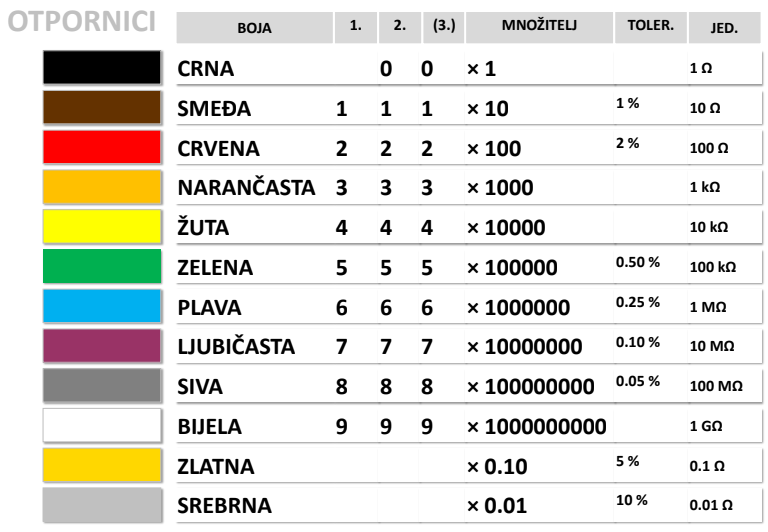
A resistor has no room for a printed number, so its value is written with coloured bands. We turn the resistor so that the gold or silver band is on the right, and read the colours from the left. The value is always in ohms (Ω).
On a resistor with four bands:
- the first two bands are digits,
- the third band is the multiplier: it tells us how many zeros to write after those digits,
- the fourth band is the tolerance, how far the real value may be from the marked one.
Example: yellow, violet, red, gold ⇒ 4 and 7, then two more zeros ⇒ 4700 Ω = 4.7 kΩ, ±5 %.
Resistors with five bands have three digits, and the fourth band is the multiplier. Example: brown, black, black, red, brown ⇒ 1, 0, 0, then two more zeros ⇒ 10 000 Ω = 10 kΩ, ±1 %.
The most common tolerances are gold = ±5 %, silver = ±10 % and brown = ±1 %. The tolerance band is often a little apart from the others. The calculator above draws only the value bands, without the tolerance.
Colour code table
Units
1 kΩ = 1000 Ω
1 MΩ = 1000 kΩ = 1 000 000 Ω
Common values
| Colours | Ω | kΩ | MΩ |
|---|---|---|---|
| red, red, brown | 220 Ω | 0.22 kΩ | |
| orange, orange, brown | 330 Ω | 0.33 kΩ | |
| yellow, violet, brown | 470 Ω | 0.47 kΩ | |
| brown, black, red | 1000 Ω | 1 kΩ | 0.001 MΩ |
| red, red, red | 2200 Ω | 2.2 kΩ | 0.0022 MΩ |
| yellow, violet, red | 4700 Ω | 4.7 kΩ | 0.0047 MΩ |
| brown, black, orange | 10 000 Ω | 10 kΩ | 0.01 MΩ |
| yellow, violet, orange | 47 000 Ω | 47 kΩ | 0.047 MΩ |
| brown, black, yellow | 100 000 Ω | 100 kΩ | 0.1 MΩ |
| brown, black, green | 1 000 000 Ω | 1000 kΩ | 1 MΩ |