
Batteries
How batteries work: types (AA, AAA, 9 V, button cells, LiPo), what V and mAh mean, why a battery gets weaker, and rules for using batteries safely.
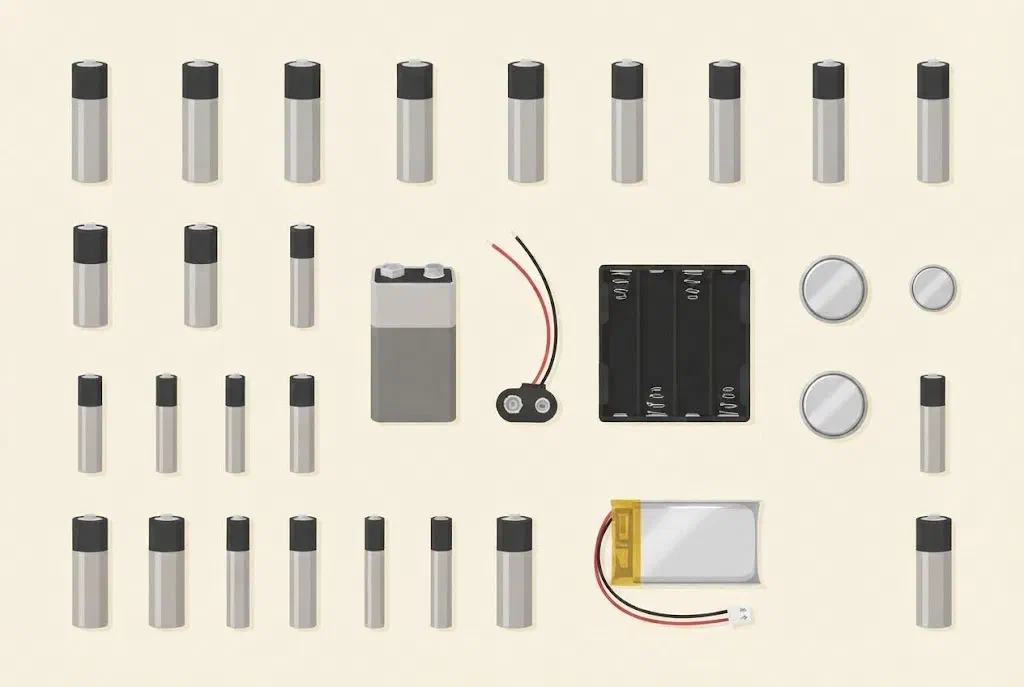
What is a battery?
A battery stores chemical energy. When we connect it into a closed circuit, the chemicals inside start to react and the battery drives a current around the circuit: from plus (+), through the wires and components, back to minus (−). When the chemicals are used up, the battery is flat.
Every battery has two terminals, plus and minus. They are marked + and − on the battery, and in a schematic a battery has its own symbol: the longer line is plus.
What is inside a battery?
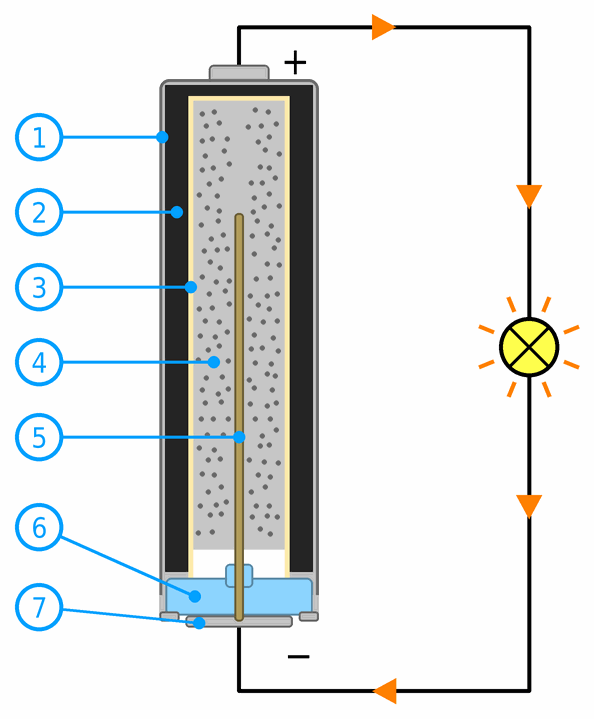
- The steel can. It is also the plus terminal, with the small bump at the top.
- Manganese dioxide, the black substance along the wall of the can. It is mixed with graphite so that it conducts better.
- The separator, a thin paper that keeps the plus and minus sides apart.
- Zinc powder in a thick gel, in the middle of the battery.
- A brass pin connects the zinc to the minus terminal.
- A plastic seal closes the battery and keeps the minus terminal apart from the can, which is plus.
- The minus terminal, a metal disc at the bottom.
The zinc and the manganese dioxide can only react when the current has a path outside: from plus through the wires and the lamp back to minus. Inside the battery the circuit is closed by the electrolyte, an alkaline liquid that soaks the separator and the zinc gel. The separator lets the electrolyte through, but doesn’t let the zinc and the manganese dioxide touch. While the circuit is open, the reaction almost stops, so a new battery in a drawer keeps its energy for years. When the zinc is used up, the battery is flat. The electrolyte burns the skin, and it is what comes out of a leaking battery.
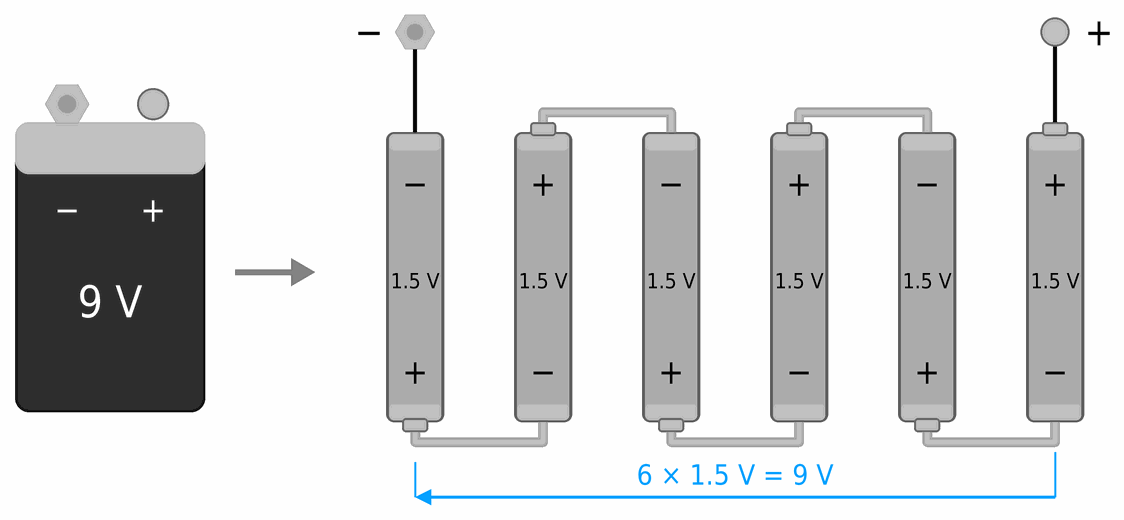
Strictly speaking, what we call an AA battery is a single cell. A real battery is several cells joined together, like the 9 V battery. Inside it there are six small 1.5 V cells, joined one after another by metal strips, the plus of one to the minus of the next, so their voltages add up: 6 × 1.5 V = 9 V.
Which batteries do we use?
| Battery | Voltage | Where we use it | Can it be recharged? |
|---|---|---|---|
| AA (code LR6) | 1.5 V | the Maqueen robot (three of them) | no |
| AAA (code LR03) | 1.5 V | the micro:bit battery holder (two of them) | no |
| 9 V (code 6LR61) | 9 V | first circuits, measurements | no |
| button cell CR2032 | 3 V | small lights, watches, remote controls | no |
| rechargeable AA (NiMH) | 1.2 V | instead of an ordinary AA | yes, with its own charger |
| LiPo and Li-ion | 3.7 V | mobile phones, drones | yes, only with a special charger |
The code LR6, LR03 or 6LR61 is printed on the battery in small letters. The letter L means it is an alkaline battery.
What is written on a battery?
- Voltage (V): how hard the battery drives a current. A new AA battery has a little over 1.5 V, and a flat one about 1 V.
- Capacity (mAh): how long the battery can keep supplying a current. More mAh doesn’t mean a stronger battery, but one that lasts longer. This is explained in misconception 7.
- A crossed-out bin: don’t throw the battery in the household rubbish, but in a box for old batteries.
When we put batteries one after another, their voltages add up: the three AA batteries in the Maqueen give 3 × 1.5 V = 4.5 V. Other ways of connecting batteries are explained in misconception 6.
Why does a battery get weaker?
As a battery runs down, its voltage slowly drops. That is why a robot with worn-out batteries drives more slowly and an LED shines more dimly.
The voltage also drops when the battery has to supply a large current. A battery that shows a good voltage on the multimeter can give out when it drives a motor. While we only measure, a tiny current flows out of it. When the motor switches on, the current rises and the battery’s voltage falls. If a robot jerks oddly, or the micro:bit restarts by itself when the motors start, change the batteries first.
Rules for batteries
- Mind plus and minus. The holder shows which way round each battery goes.
- Don't mix old and new batteries, or batteries of different kinds.
- Never charge a battery that doesn't say it can be recharged. It can leak or burst.
- Don't connect a battery's plus and minus with a wire or a piece of metal: that is a short circuit. Don't carry a 9 V battery in a pocket with keys and coins.
- If a battery gets hot, swells up or leaks, switch the circuit off at once and call the leader. Don't touch the white or crystal-like substance around a leaking battery: it burns the skin.
- Take the batteries out of a device you won't use for a long time, because over time they can leak.
- Take old batteries to a box for old batteries. Many shops and schools have one.
Button cells are not for little ones
A button cell looks like a sweet or a coin, and if it is swallowed it is very dangerous: within a few hours it can burn the inside of the throat. Keep button cells, new and used, away from younger brothers and sisters. If someone swallows a battery, they must go to hospital at once, without waiting for signs to appear.
Rechargeable batteries and LiPo
This part is for the Arduino workshop and for projects such as the Drone.
NiMH
A rechargeable AA battery (NiMH) has 1.2 V instead of 1.5 V. Most devices work just as well with it, because the voltage of an ordinary AA battery soon drops below 1.5 V anyway. Three rechargeable batteries give 3.6 V instead of 4.5 V, so the robot may drive a little more slowly. They are charged only with a NiMH charger.
Li-ion and LiPo
Lithium batteries store a lot of energy in a small, light package, so they are in mobile phones, laptops and drones. One cell has 3.7 V. Full, it has 4.2 V, and while it is working its voltage mustn’t fall below about 3.3 V. A cell that is run down further is permanently damaged.
A LiPo battery can supply a very large current. How much it may supply is given by the C rating: a 500 mAh, 20C battery may supply up to 20 × 0.5 A = 10 A. That same ability makes it dangerous: in a short circuit the current rises to tens of amps, and the battery can catch fire.
It is also dangerous when a short circuit happens inside the battery. Inside, a LiPo cell is a stack of thin layers:
- the pouch, made of aluminium foil covered with plastic,
- plus electrodes: aluminium foil coated with a lithium compound,
- separators: a thin plastic film soaked in electrolyte, only about 20 micrometres thick, thinner than a hair,
- minus electrodes: copper foil coated with graphite.
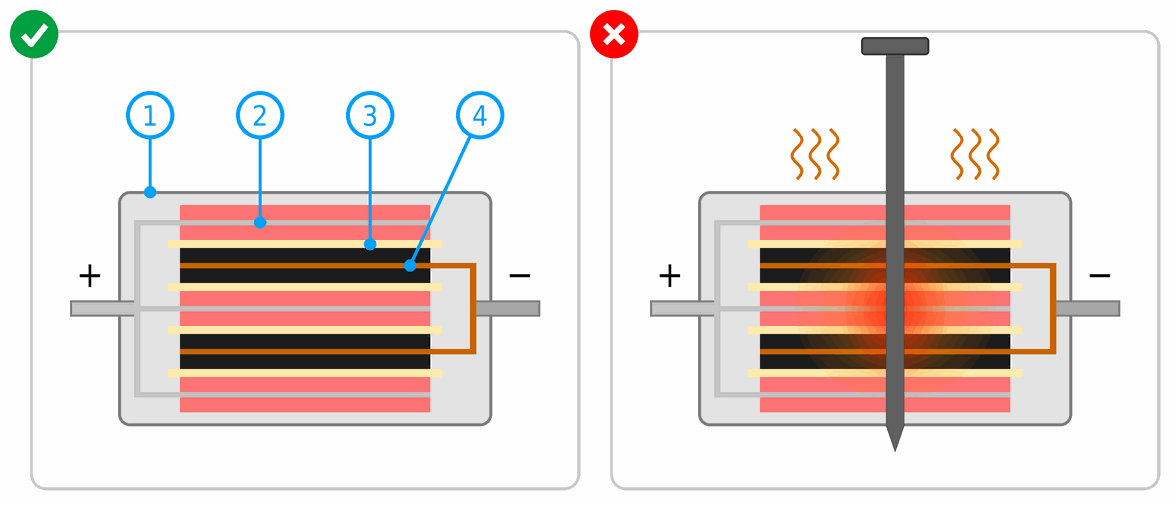
Mobile phones and ready-made battery packs have a protection circuit that disconnects the battery when the current is too high or the voltage too low. LiPo batteries for models and drones often have none, so we have to look after the battery ourselves.
Rules for LiPo batteries
- A LiPo battery is charged only by an adult, with a LiPo charger, in a fireproof bag and never unattended.
- Don't bend, puncture, squash or short-circuit the battery. Don't carry it loose in a bag.
- Keep the cell voltage between 3.3 V and 4.2 V. If you won't use the battery for a long time, leave it half charged (about 3.8 V per cell).
- Hand a swollen, knocked or damaged battery to the leader straight away. Don't use it or charge it.
- For measurements on the test bench, use a bench power supply with current limiting instead of a LiPo battery.
How long does a 9 V battery last?
A 9 V battery has a small capacity, about 500 mAh. An Arduino Uno with nothing connected uses about 50 mA, so such a battery would power it for about ten hours:
 What did we learn?
- A battery stores chemical energy and drives a current from plus, around the circuit, back to minus.
- Inside a battery the plus and minus sides are kept apart by a separator. The reaction only runs while the circuit is closed.
- Voltage (V) tells us how hard the battery drives a current, and capacity (mAh) for how long it can.
- A battery gets weaker as it runs down and when it has to supply a large current, for example to a motor.
- We don’t mix batteries, short-circuit them or charge them unless they say they can be recharged. We keep button cells away from small children.
- LiPo batteries store a lot of energy and can catch fire, so only an adult charges them, with a special charger and under supervision.
Short quiz
1. What voltage do three AA batteries give when put one after another?
2. Yesterday the robot drove fast, and today it drives slowly and jerks. What do you check first?
3. May you have one new and two old batteries in the same holder?
4. A younger brother is playing with a button cell. Why is that dangerous?
5. A 1000 mAh LiPo battery is rated 25C. What is the largest current it may supply?
6. You notice that a LiPo battery has swollen up. What do you do?
7. What is the separator in a battery for?