
Resistor
What a resistor does, how to read the colour code, Ohm's law, series and parallel, a resistor's power, and why the values you can buy come from the E12 series.
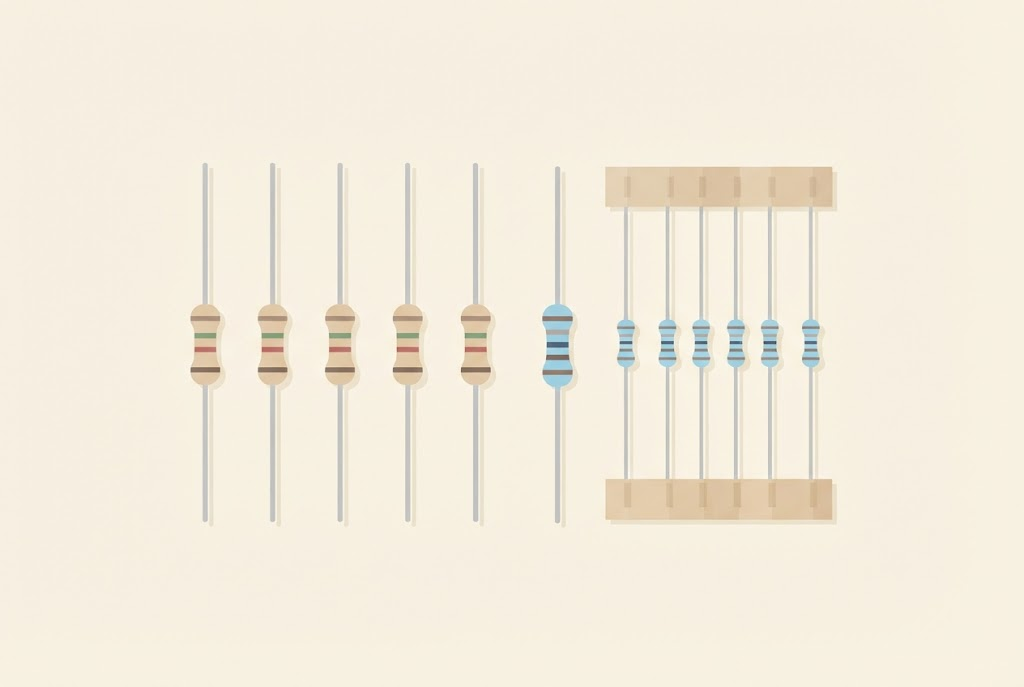
What is a resistor?
A resistor is a component that resists current. The larger its resistance, the smaller the current that flows through it at the same voltage. Think of water in a hose: water flows easily through a wide hose, and less of it flows through a narrow one, even with the tap opened just as far.
So we use a resistor to limit the current, for example so that an LED or an Arduino pin doesn’t burn out. A resistor doesn’t use up current: as much current comes out of one leg as goes into the other (misconception 1).
Resistance is measured in ohms (Ω). For larger values we use kilohms (1 kΩ = 1000 Ω) and megohms (1 MΩ = 1,000,000 Ω).

A resistor has no plus and minus, so it can go either way round. In a schematic we draw it as a rectangle in Europe and as a zigzag line in American schematics. You will find the other symbols on the page Electronic components, symbols and schematics.
How do we write a value?
You can see the same value written in three ways:
| Style | Example | Where you see it |
|---|---|---|
| in ohms | 4700 Ω | in calculations, for example with Ohm’s law |
| with the prefix k or M | 4.7 kΩ | in text, on this page, on a multimeter |
| a letter instead of the decimal point | 4k7 | in schematics, on bags and strips of resistors |
The prefix k (kilo) means a thousand times, and M (mega) a million times. To go from kilohms to ohms, multiply by 1000: 4.7 kΩ = 4.7 × 1000 Ω = 4700 Ω. To go back, divide by 1000: 4700 Ω / 1000 = 4.7 kΩ.
In the style 4k7 the letter stands where the decimal point would be: 4k7 is 4.7 kΩ, 2k2 is 2.2 kΩ, and 1M5 is 1.5 MΩ. For values below 1 kΩ the letter R is used: 4R7 is 4.7 Ω, and 220R is 220 Ω. The Ω sign is then left out, so a schematic just says 10k or 220R. This style has two advantages:
- A small decimal point easily gets lost when a schematic is printed or photocopied, and then 4.7 could be read as 47. A letter doesn’t get lost.
- In English we write 4.7 kΩ, with a point, and in Croatian and many other languages 4,7 kΩ, with a comma. 4k7 is the same in every language.
The colour code
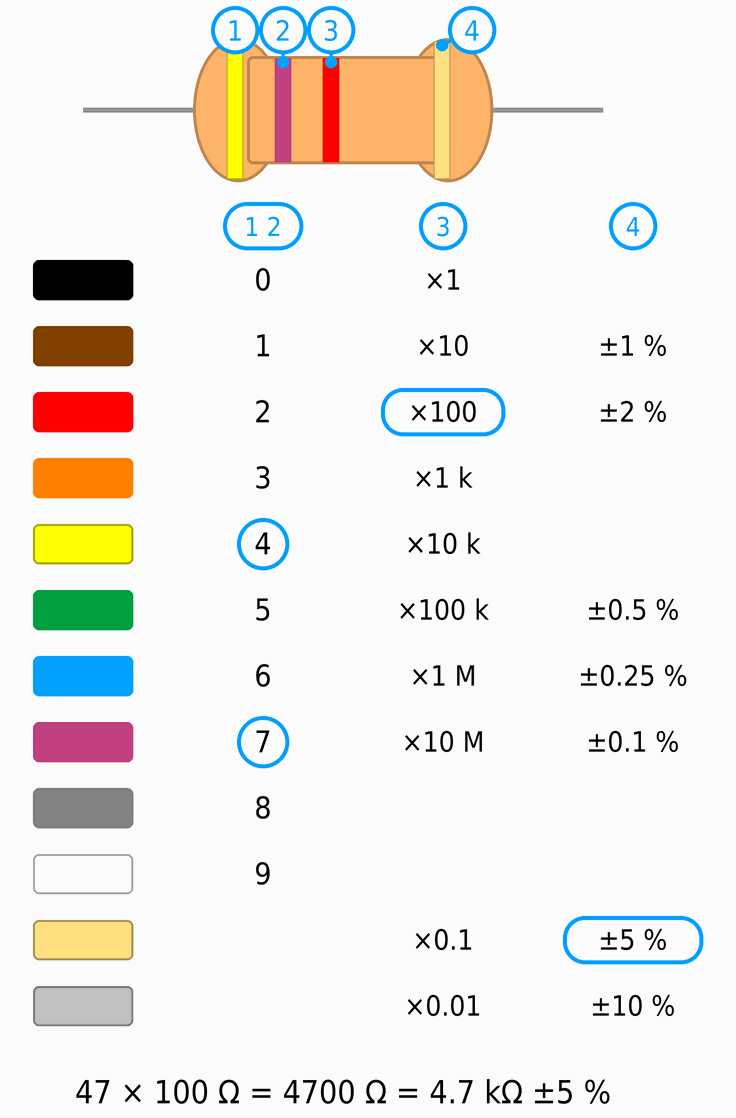
Resistors are too small to have a number printed on them, so the value is written with coloured bands. The most common resistors have four bands:
- the first band is the first digit,
- the second band is the second digit,
- the third band says how many times to multiply those two digits,
- the fourth band, set apart from the others, is the tolerance: how far the real resistance may differ from the marked one.
| Colour | Digit | Multiplier | Tolerance |
|---|---|---|---|
| black | 0 | ×1 | |
| brown | 1 | ×10 | ±1 % |
| red | 2 | ×100 | ±2 % |
| orange | 3 | ×1 k | |
| yellow | 4 | ×10 k | |
| green | 5 | ×100 k | ±0.5 % |
| blue | 6 | ×1 M | ±0.25 % |
| violet | 7 | ×10 M | ±0.1 % |
| grey | 8 | ||
| white | 9 | ||
| gold | ×0.1 | ±5 % | |
| silver | ×0.01 | ±10 % |
The example in the picture: yellow (4), violet (7), red (×100) and gold (±5 %) mean 47 × 100 Ω = 4700 Ω = 4.7 kΩ. The real resistance may be 5 % lower or higher, from 4465 Ω to 4935 Ω.
Resistors with five bands
More precise resistors have five bands. They are often light blue, not beige like ordinary ones. They have one more digit:
- the first band is the first digit,
- the second band is the second digit,
- the third band is the third digit,
- the fourth band is the multiplier,
- the fifth band, set apart from the others, is the tolerance, most often brown (±1 %) or red (±2 %).
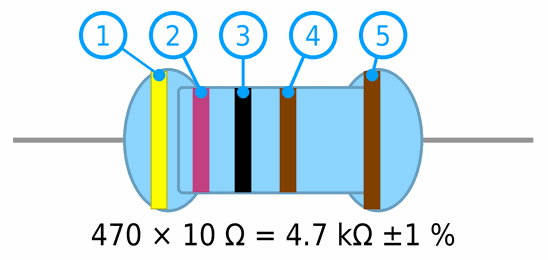
The colours mean the same as in the table above. A 4.7 kΩ resistor with five bands has yellow (4), violet (7), black (0), brown (×10) and brown (±1 %): 470 × 10 Ω = 4700 Ω = 4.7 kΩ. Its real resistance may be only 1 % off, from 4653 Ω to 4747 Ω.
Tips for reading it:
- First count the bands. With four bands the multiplier is the third one, and with five bands the fourth.
- Turn the resistor so that the tolerance band, set apart from the others, is on the right. Then read from the left. With four bands this is usually the gold or silver band.
- With five bands the tolerance is often brown, and brown can also be the first digit. Then the gap helps: the tolerance band is further from the others, and the first band is closer to the end of the resistor.
- If you aren’t sure about the colours, measure the resistance with a multimeter or work it out with the resistor calculator.
Ohm’s law
How much current flows through a resistor depends on the voltage across it and on its resistance. This is what Ohm's law says:
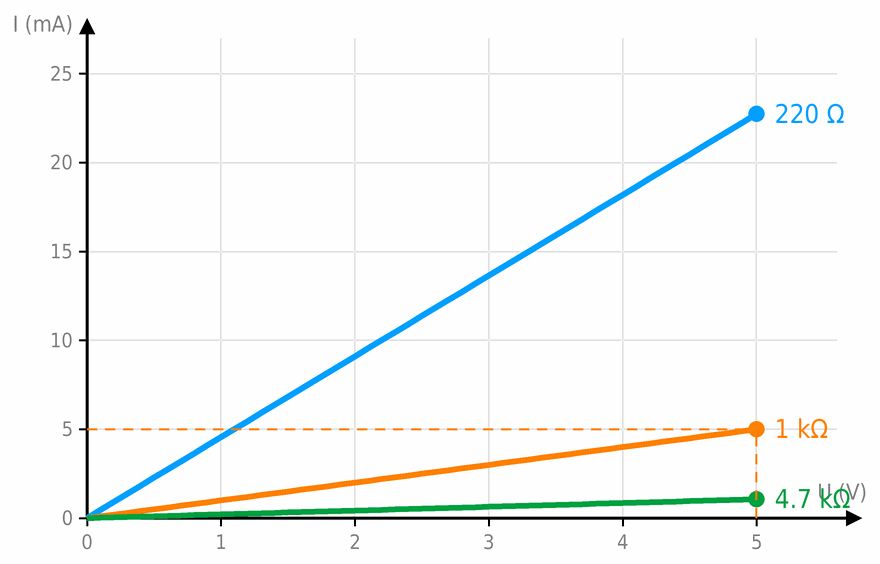
The graph shows the current through three resistors as the voltage rises from 0 to 5 V. Each one is a straight line: twice the voltage gives twice the current. The smaller the resistance, the steeper the line. At 5 V about 23 mA flows through 220 Ω, and only about 1 mA through 4.7 kΩ.
Series and parallel
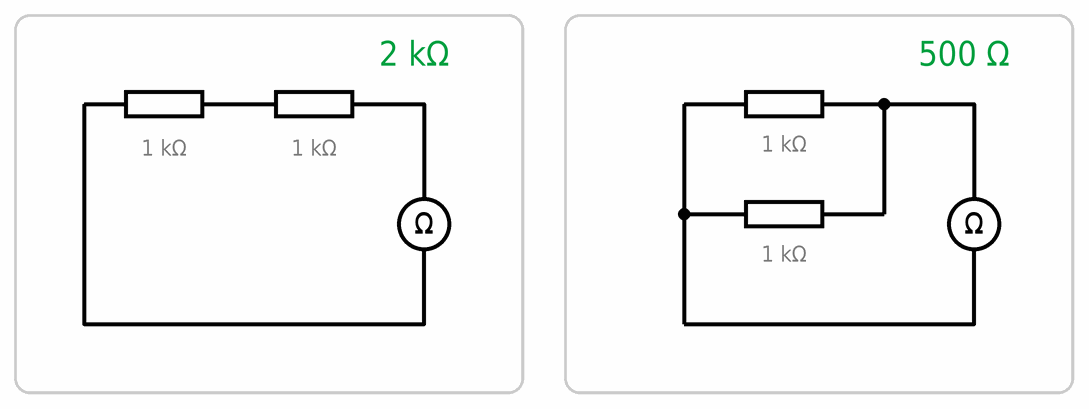
- In series, one after the other: the resistances add up. Two 1 kΩ resistors give 2 kΩ.
- In parallel, side by side: the current has two paths, so the total resistance is smaller than each one. Two equal resistors give half the resistance: two of 1 kΩ give 500 Ω.
For different resistors these formulas apply:
The resistor in the Arduino workshop
From here on, this page is for the Arduino workshop.
A resistor’s power
A resistor turns electrical energy into heat. The power it turns into heat is:
Why those values?
In a shop you won’t find a 2000 Ω resistor, but you will find 1.8 kΩ and 2.2 kΩ. Resistors are made in series of values, and the most common is the E12 series, with 12 values in each decade:
1.0 – 1.2 – 1.5 – 1.8 – 2.2 – 2.7 – 3.3 – 3.9 – 4.7 – 5.6 – 6.8 – 8.2
multiplied by 1, 10, 100, 1000… (220 Ω, 4.7 kΩ, 68 kΩ). Each value is about 1.2 times the one before. Why like that? Because of the tolerance. A 1.0 kΩ resistor with a tolerance of ±10 % can be anything from 0.9 to 1.1 kΩ, and a 1.2 kΩ one from 1.08 to 1.32 kΩ. The ranges touch or overlap (only two tiny gaps are left, around 1.33 and 2.42), so almost every value between 1 and 10 is covered by at least one resistor in the series. There is no point in making 1.1 kΩ when 1.0 and 1.2 kΩ already cover it.

Resistors with a smaller tolerance (±5 %) also come in the denser E24 series, with 24 values per decade (2.0, 2.4, 3.0, 5.1…), and precise five-band resistors (±1 %) in the E96 series, with 96 values. When you work out a resistance that isn’t in the series, take the nearest value from the series. For a resistor that limits a current, next to an LED or on a transistor’s base, take the next larger one, so that the current is a little smaller, not larger.
The resistor in a circuit
In the workshop’s circuits a resistor has several jobs:
- it limits the current of an LED or a pin: see the LED page and the resistor for an LED calculator,
- it divides a voltage: two resistors in series are a voltage divider, described in the lesson Voltage divider, Arduino and PWM,
- it holds an input in a known state: a pull-up or pull-down resistor next to a button, from the lesson Buttons done right,
- it protects a pin when we connect two Arduinos, as on the Short circuit page.
SMD resistors
On factory-made boards, including the Arduino itself, resistors are tiny rectangles without legs (SMD, from surface mount device). They carry a three-digit number: the first two are digits, and the third is how many zeros to add. 472 is 47 and two zeros, 4700 Ω = 4.7 kΩ, and 103 is 10,000 Ω = 10 kΩ. The letter R stands where the decimal point would be, as in the 4k7 style: 4R7 is 4.7 Ω.
 What did we learn?
- A resistor resists current and so limits it. Resistance is measured in ohms (Ω), and a resistor has no plus and minus.
- We write the same value as 4700 Ω, 4.7 kΩ or 4k7, where the letter stands where the decimal point would be.
- We read a resistor’s value from its coloured bands: two digits (three with five bands), a multiplier and the tolerance.
- By Ohm’s law the current is the voltage divided by the resistance: I = U / R.
- In series the resistances add up, and in parallel the total resistance is smaller than each one.
- A resistor turns energy into heat, so besides the resistance we must also mind its power. Resistor values come from the E12 and E24 series.
Short quiz
1. What is the value of a resistor with the bands red, red, brown, gold?
2. Which colours are the first three bands of a 10 kΩ resistor?
3. What current flows through a 220 Ω resistor at a voltage of 5 V?
4. What is the total resistance of two 2.2 kΩ resistors in series, and what is it in parallel?
5. Why mustn't you connect a 100 Ω resistor straight across a 9 V battery?
6. You worked out that an LED needs 200 Ω. Which resistor from the E12 series do you take?
7. What is the value of a resistor with the bands red, red, black, black, brown?
8. A schematic says 2k2. How do you write that in ohms, and how with a prefix?