
Static electricity
Why a door handle zaps you in winter, how a spark you can't feel damages a chip, and how to protect electronics from static electricity.
A balloon and your hair
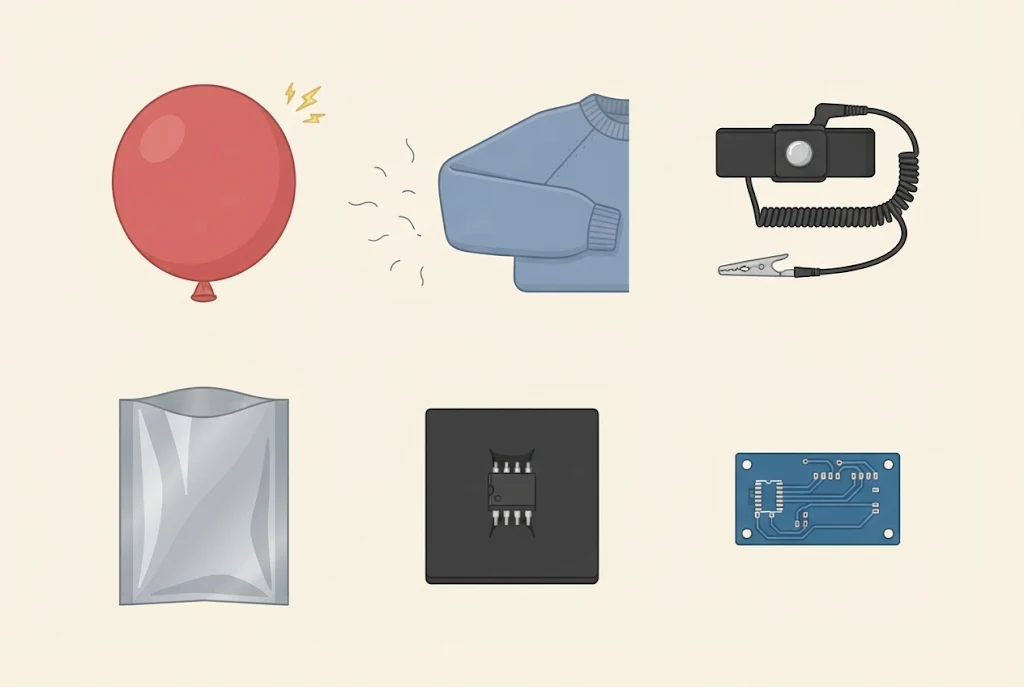
Rub a blown-up balloon on dry hair or a woollen jumper, then slowly move it away. Your hair rises towards the balloon, and the balloon sticks to a wall.
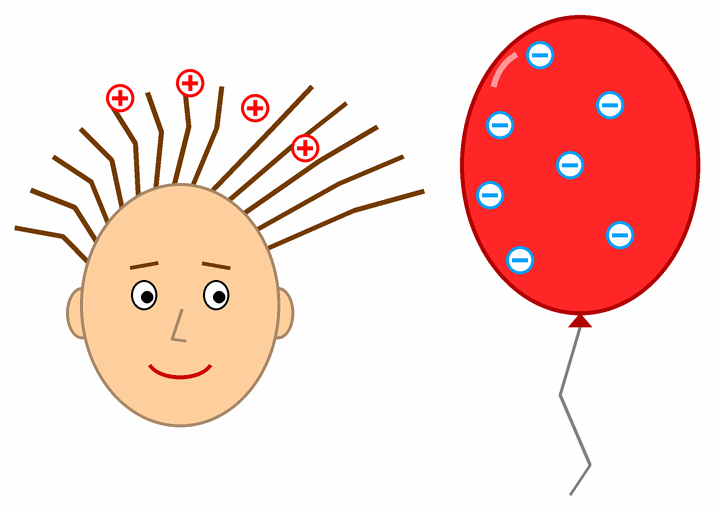
Everything is made of tiny particles with a charge: positive protons (plus) and negative electrons (minus). Usually there are just as many of each, so you don’t notice them. When you rub the balloon on your hair, some electrons move from your hair to the balloon. The balloon then has extra minus, and your hair extra plus. Plus and minus attract each other, so your hair rises towards the balloon. And the hairs, which all have plus, push each other away, so your hair stands on end.
Charge like this that stays on an object is called static electricity. Static means it stays still: it doesn’t flow through a wire like a current, it waits on the object.
Why does a door handle zap you?
When you walk on a carpet, especially in woollen socks or slippers, your body collects charge, like the balloon. When your finger comes close to a metal door handle, the charge jumps across to it in a split second as a tiny spark. That is the zap you feel.
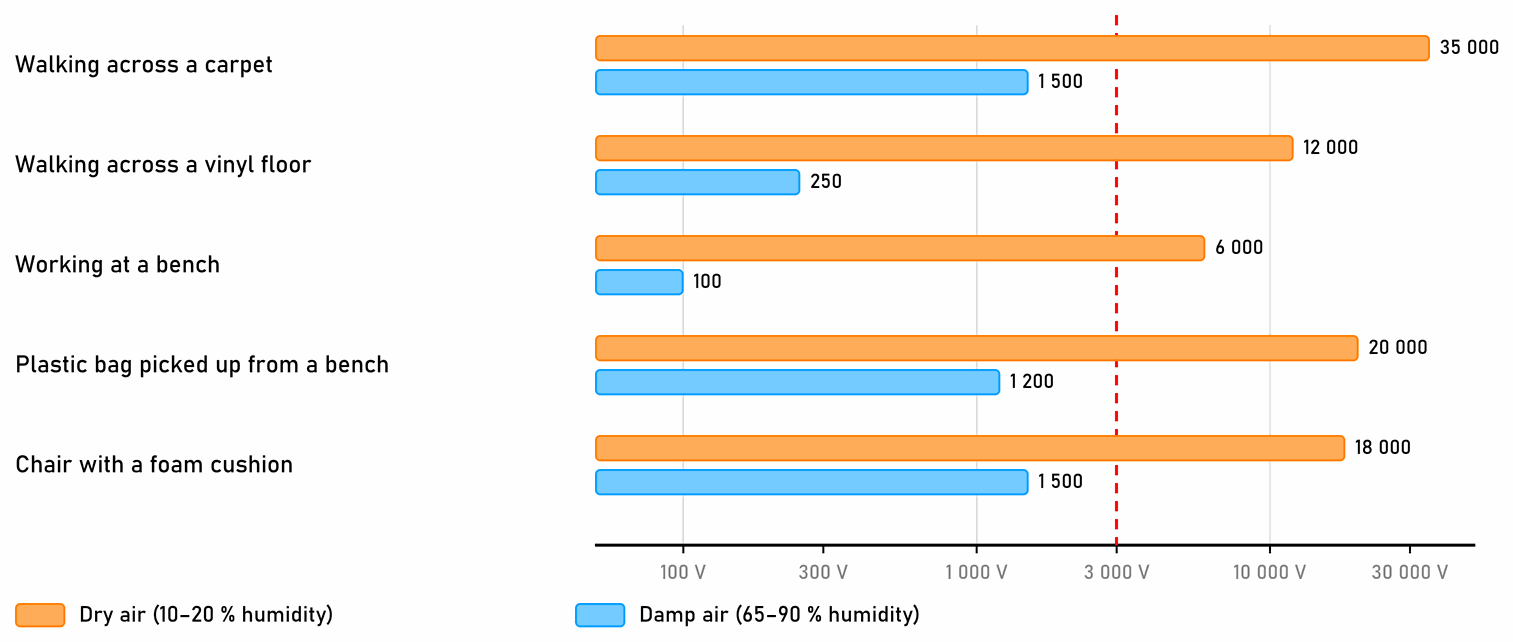
You feel a spark only once you are charged to about 3000 V (the red dashed line). The graph shows that this happens easily in winter: walking across a carpet in dry air charges you up to 35,000 V. In damp air the charge slowly leaks away into the air, so you charge up much less. That is why door handles zap you in winter, when the heating is on and the air is dry, and hardly ever in summer.
A spark like that does you no harm: it lasts less than a millionth of a second and has very little energy in it. But it can harm electronics.
Why is static electricity dangerous for electronics?
Chips are made of very tiny parts, and some layers in them are thinner than a thousandth of the thickness of a hair. A spark you don’t feel at all, of a few hundred volts, can break through such a layer. The chip then:
- stops working straight away,
- works, but wrongly: a pin doesn’t read properly, a sensor gives the wrong values,
- works normally, then fails weeks later.
The last two are the worst, because you don’t know that the damage happened just then. Misconception 23 says the same: static electricity can damage electronics, without you noticing anything.
How to protect electronics
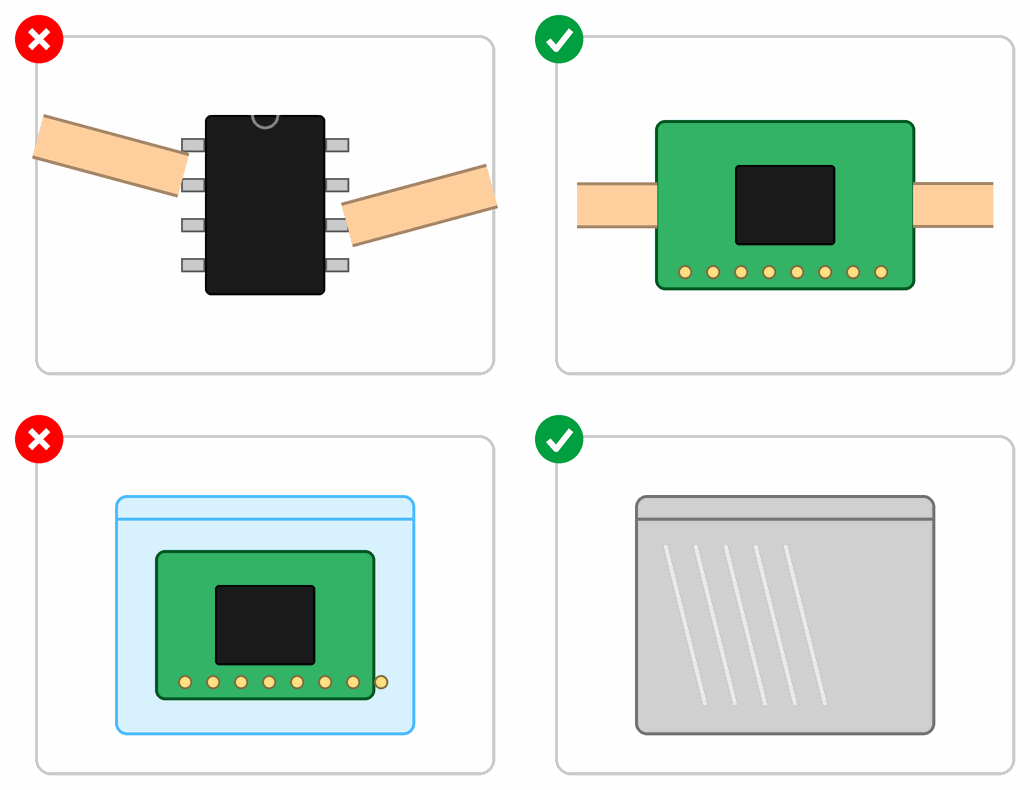
- Before you start, touch earthed metal, such as a metal radiator or the metal case of an earthed device. The charge then goes from you into the ground, not into a chip. Touch it again when you have got up and walked around.
- Hold boards and modules by their edges. Don’t touch the legs of chips, pins or connectors.
- Keep components in antistatic bags. A silvery bag is a shielding bag: charge goes round its surface, past the chip. A pink bag doesn’t build up charge, but it doesn’t shield against a spark from outside. Chips often arrive pushed into black conductive foam, which keeps all their legs connected. An ordinary plastic bag and polystyrene build up charge, so we don’t put electronics in them.
- Don’t wear wool or fleece at the workbench, and the chair shouldn’t be covered in plastic. Cotton charges up much less.
- Don’t charge yourself up on purpose (by rubbing your feet on the carpet) near electronics.
Static electricity in the Arduino workshop
This part is for the Arduino workshop (ages 12 and up).
The human body model
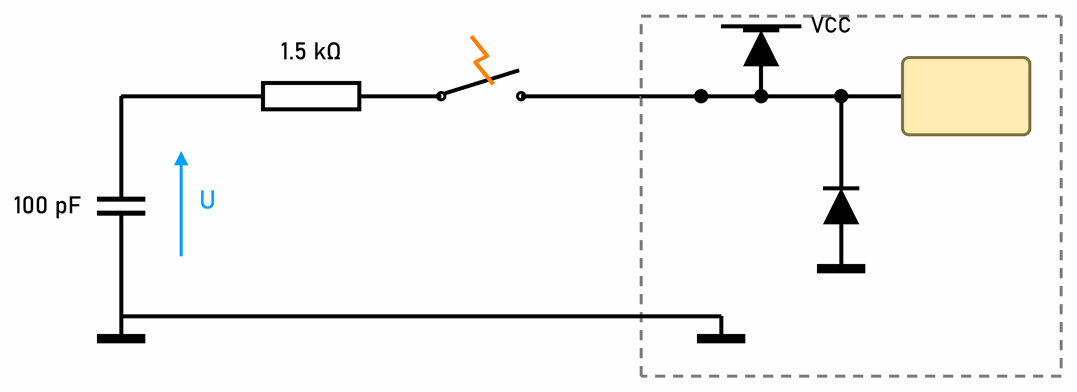
Makers test chips with the human body model (HBM). In it, the body is a capacitor of 100 pF charged to a voltage U, and the skin and finger are a resistor of 1.5 kΩ. When the finger touches a pin, the capacitor discharges through the resistor into the chip.
Every pin has two protection diodes: one to VCC and one to GND. When the voltage on the pin rises above VCC or falls below GND, one of them conducts and carries the current past the inside of the chip. But the diodes are tiny and have their limit.
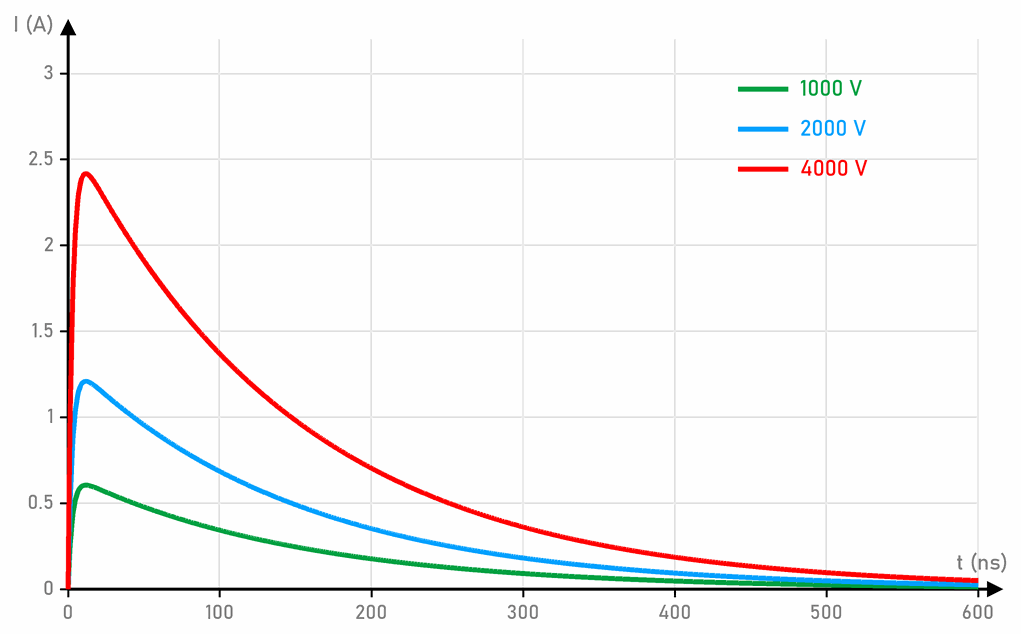
We can work out the discharge current. At the start it is largest, about U / 1500 Ω, then it falls as the capacitor empties, with a time constant τ = R · C = 1500 Ω · 100 pF = 150 ns. For 4000 V:
- the largest current is about 2.7 A (about 2.4 A in the graph, because the current takes a few nanoseconds to rise),
- after about 350 ns the current has fallen to a tenth,
- the charge is Q = C · U = 0.4 µC, and the energy E = ½ · C · U² = 0.8 mJ.
That is fifty times less energy than an LED uses in one second, so it does you no harm. But a current of a few amps goes through a chip that is made for milliamps, and through its thinnest parts.
Most chips have protection tested at about 2000 V in this model. That is less than the voltage you collect walking across a carpet in winter. More sensitive parts, such as some MOSFETs, sensors and radio chips, survive only a few hundred volts or less. How much a chip survives is in its datasheet, under ESD or HBM.
The antistatic wrist strap
In workshops where electronics is made or repaired, people work with an antistatic wrist strap and mat. The strap is connected by a cable to an earthing point, through a 1 MΩ resistor. The resistor is there for safety: if your hand touches a voltage by accident, only a very small current can flow through your body. That is why a wrist strap is never connected straight to earth without the resistor, and we never connect one to a socket ourselves.
In our workshop it is enough to touch earthed metal before you start and to hold boards by their edges.
MOSFETs and modules
A MOSFET has a very thin layer of insulation between its gate and the rest of the transistor, so static electricity breaks through it easily. If a MOSFET (like the IRLZ44N in the pinball machine) doesn’t switch off or on properly after soldering, the cause may also be a spark that nobody saw. So:
- we keep MOSFETs in conductive foam or a bag until they are soldered,
- we solder the resistor from the gate to GND (the pull-down) next to the MOSFET, because then the gate is never left floating, charged to a random voltage.
On ready-made modules (sensors, ESP32 boards, RFID readers) the pins on the header usually go straight to the chip, without extra protection. Hold them by the edges and keep them in the bags they came in.
 What did we learn?
- Static electricity is charge that stays on an object or a body, like on a balloon rubbed on your hair.
- You feel a spark only from about 3000 V, but a chip can be damaged by a few hundred volts.
- In dry winter air you charge up much more than in summer.
- Before you start, touch earthed metal, hold boards by the edges and keep components in antistatic bags.
- A damaged chip can work wrongly or fail much later.
Quick quiz
1. Why does your hair rise towards a balloon you have rubbed on it?
2. Why does a door handle zap you in winter and hardly ever in summer?
3. You didn't feel any spark when you touched a chip. Does that mean the chip is certainly fine?
4. What do you do before you take a module out of its bag?
5. Why don't we keep electronics in ordinary plastic bags?
6. Why does an antistatic wrist strap have a 1 MΩ resistor?