
How fast does the motor spin?
What's inside a DC motor and why it has a gearbox; we measure how far the Maqueen robot drives in 2 seconds at different speeds.
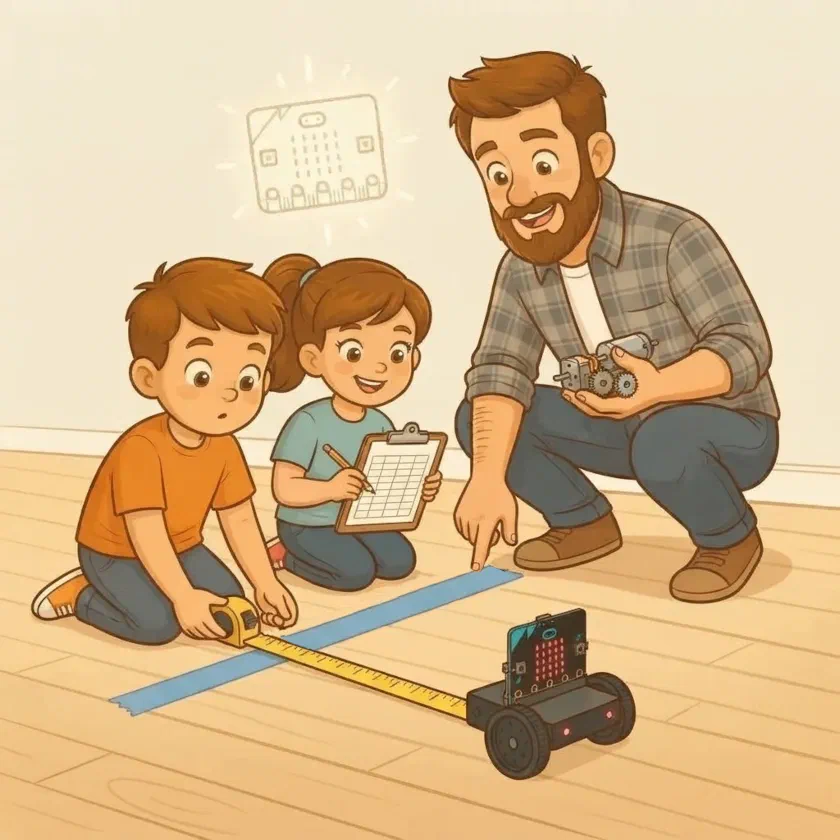
Today we’ll look inside a motor, and then measure how far the robot drives at different speeds. You’ll need the table you make today next time too.
Today we will:
- find out what’s inside a motor;
- find out why a motor has gears;
- measure how far the robot drives in 2 seconds;
- find the lowest speed at which the robot still drives.
Materials
- a Maqueen robot with a micro:bit;
- a tape measure;
- sticky tape for a start line on the floor;
- a sheet with the table and a pencil (an A4 page has three tables, which the instructor cuts apart);
- a clear lane on the floor, at least 2 metres long.
What’s inside a motor?
The robot has two small DC motors. DC stands for direct current: current that doesn’t change direction by itself, like the current from a battery.
Each motor has two important parts:
When current flows through the coil, the coil becomes a magnet too. Magnets attract and repel each other, so the magnet pushes the coil and it turns. The motor’s shaft turns with it.
Experiment: a motor on a battery
The instructor connects a motor, without the robot, to a battery pack. The motor turns. Then the instructor swaps the two wires, plus and minus.
Predict: what will happen when the instructor swaps the wires?
That’s exactly what the Maqueen’s chip does when you choose Forward or Backward in the block: it sends the current through the motor one way or the other. And when you choose a speed, the chip gives the motor more or less power.
Why does a motor have gears?
A small motor turns very fast, many times a second, but it’s weak. If it were connected straight to a wheel, the robot couldn’t even start moving.
So the motor has a gearbox: a row of gears. A small gear on the motor turns a bigger gear. The big gear turns more slowly, but more strongly.
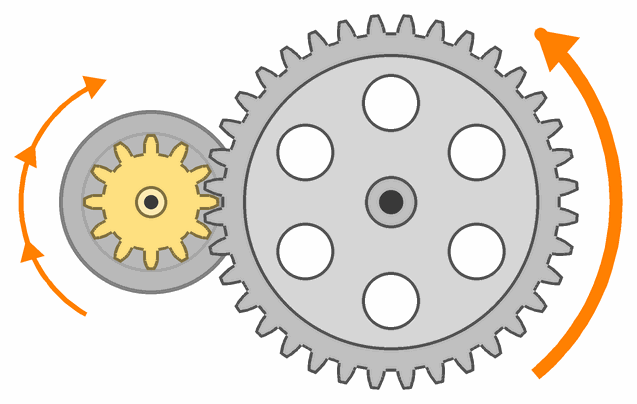
You know this from a bicycle. When you ride uphill, you change to an easier gear. You pedal fast, and the bicycle goes slowly, but easily. The gearbox gives the robot an easy gear: the wheels turn more slowly, but the robot has the strength to start moving.
Exercise 1: Measure the speed
Program: Brzina, step 1 Technique: measuring and a table
The robot will drive for exactly 2 seconds, and you’ll measure how far it got. You choose the speed with button B.
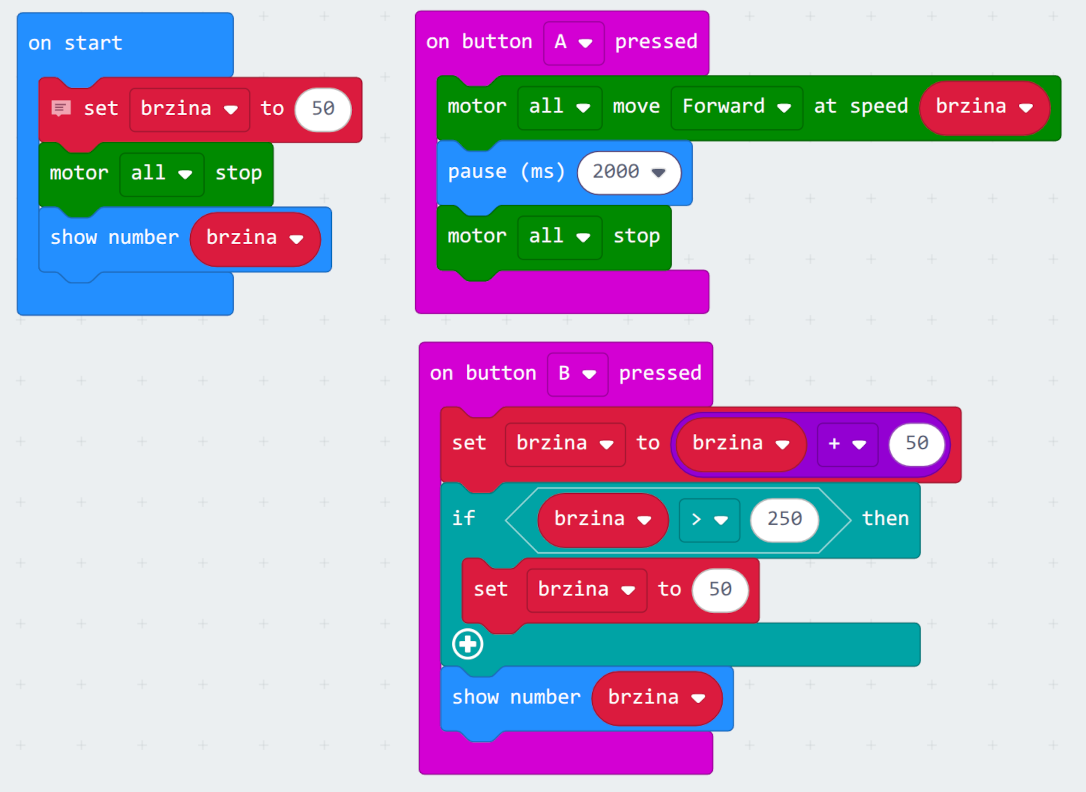
Start a new project, call it Brzina (Croatian for “speed”) and add the maqueen extension. The speed is kept in the variable brzina. When you press B, the speed goes up by 50, and after 250 it starts again at 50.
How we measure
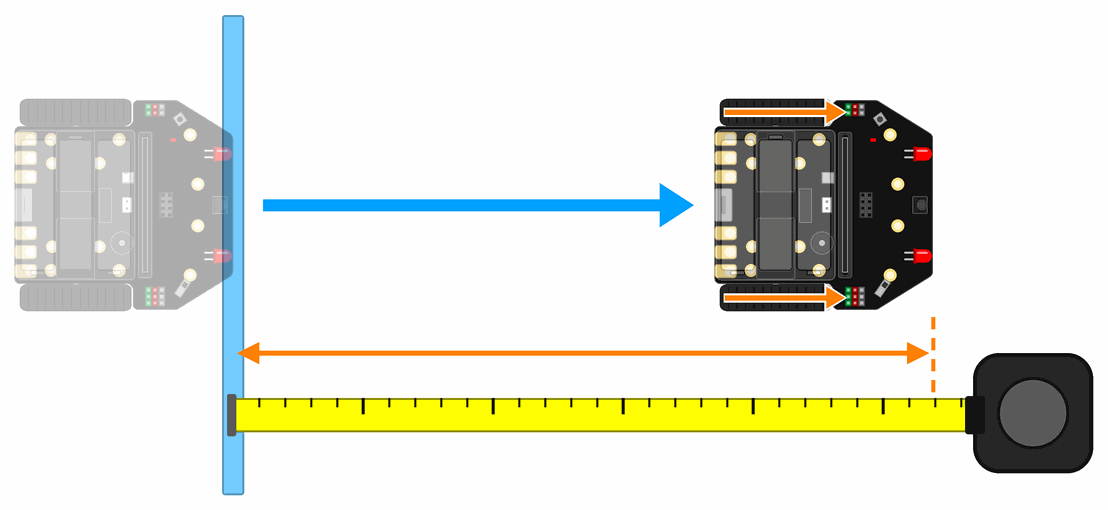
- Stick the start line on the floor.
- Put the robot with its front end on the line.
- Choose the speed with button B, then press A and take your hand away.
- When the robot stops, measure with the tape measure from the line to the front end of the robot.
- Write the number in the table and put the robot back on the line.
Predict
Before you measure, guess: how far will the robot get at speed 100? And at speed 200, will it get twice as far?
Measure
| Speed | Distance in 2 seconds (cm) |
|---|---|
| 50 | |
| 100 | |
| 150 | |
| 200 | |
| 250 |
When the table is full, look at it. Does the distance grow with the speed? Does the robot drive twice as far at speed 200 as at 100?
If the robot drifts to one side at some speed, don’t worry. It’s not a fault; it’s the topic of the next lesson.
Exercise 2: The slowest robot
Program: Brzina, step 2 Technique: exploring
What is the lowest speed at which the robot still drives? We carry on in the Brzina project.
Change four numbers: let the speed start at 10, go up by 10, and start again at 10 after 100.
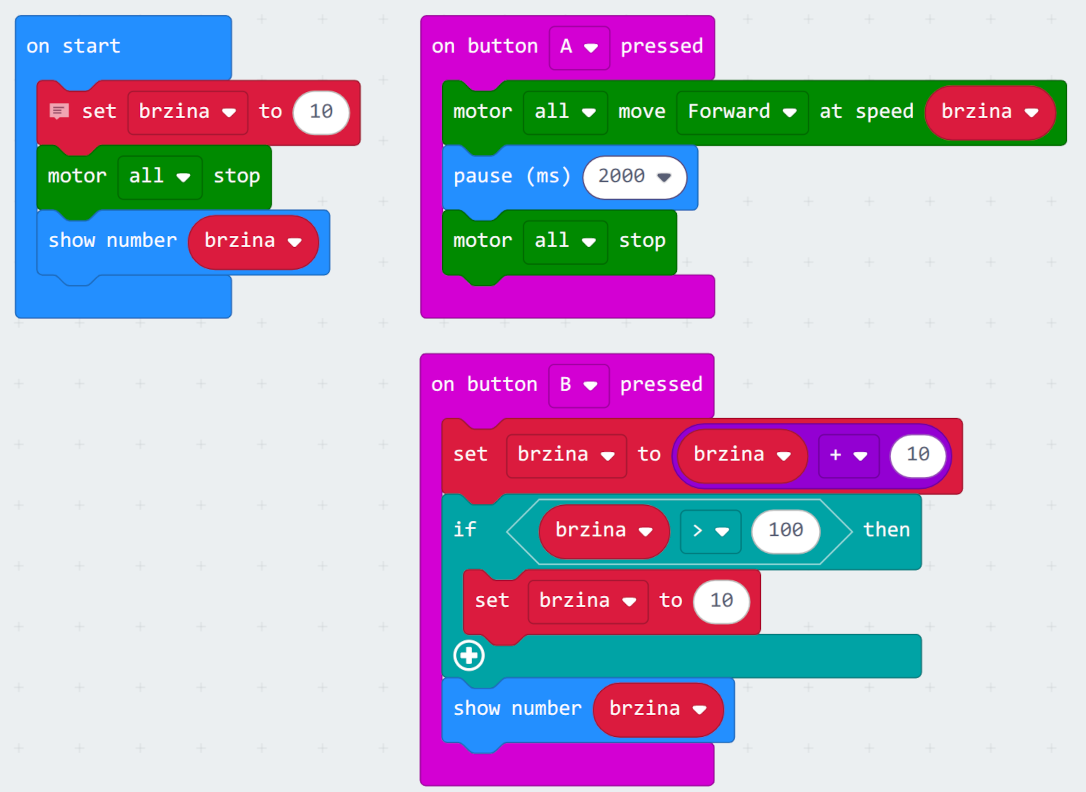
Start at 10 and raise the speed until the robot moves. Write down the lowest speed at which the robot drives:
My robot only drives from speed ______.
At a lower speed the motor hums, but the wheels don’t turn. The motor then has too little power to overcome the friction in the gears and wheels. Once the robot is moving, it often keeps going even at a slightly lower speed than the one it started at.
For those who want more: centimetres per second
We measure a car’s speed in kilometres per hour. We can measure the robot’s speed in centimetres per second. The robot drove for 2 seconds, so divide the distance by 2.
For example: if the robot covered 60 cm in 2 seconds, its speed is 60 ÷ 2 = 30 cm per second.
Work out the speed for every row of the table and write it in the cm per second column.
Compare
- Put your robot on the start line next to your neighbour’s robot. Let both drive at speed 150. Do they get equally far?
- The instructor puts old batteries in one robot. How far does it get at speed 150 now?
Robots aren’t identical, even when they’re the same kind. And as the batteries run down, the robot drives more slowly. That’s why every participant measures their own robot, with good batteries.
Keep the table!
The table is a measurement of your robot. Next time you'll use it to work out how long the robot has to drive to cover a given distance.
Extra tasks
- Backward. Measure whether the robot drives as far backward as forward.
- Snail race. You and your neighbour choose the lowest speed at which your robots drive. Whose robot covers 30 cm first?
- Draw a graph. On squared paper, draw a dot for each row of the table: the speed from left to right, the distance from bottom to top. Do the dots lie on a straight line?
What’s next?
Next time the robot drives to a plan: a square and a slalom. You’ll need the table from this lesson for that.
 What did we learn?
- A DC motor has a magnet and a coil. When current flows through the coil, the magnet pushes it and it turns.
- When the current flows the other way, the motor turns the other way.
- A gearbox is a row of gears: the wheel turns more slowly, but more strongly.
- The higher the speed in the block, the further the robot drives in the same time.
- Below a certain speed the motor has too little power to overcome friction, so the robot stands still.
- Every robot is a little different, and with weak batteries it drives more slowly.